

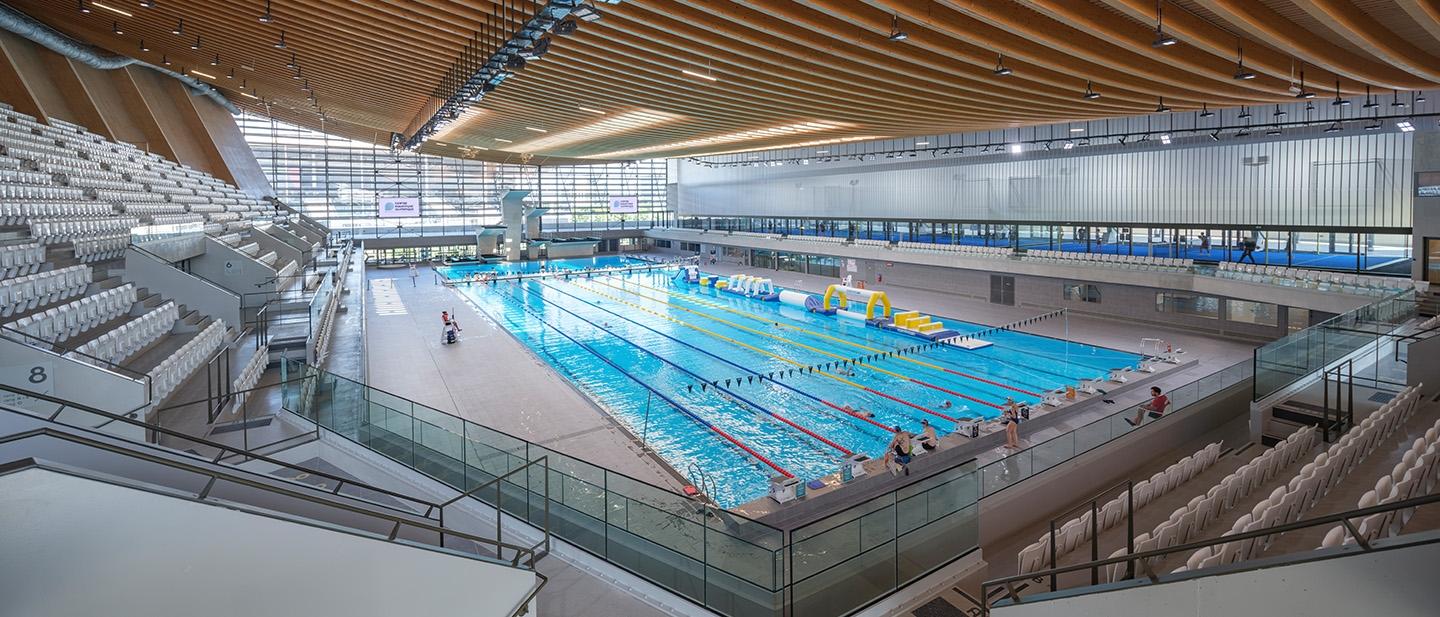
The history of the Paris Olympic Aquatics Centre (CAO MGP)
From Paris 2024 to the transformation of Greater Paris
Discover the history of the Paris Olympic Aquatics Centre (CAO MGP), the only permanent competition venue built for the Paris 2024 Olympic and Paralympic Games and a symbol of the transformation of the Plaine Saint-Denis district.
A territory transformed over two centuries
The history of the Paris Olympic Aquatics Centre (Centre Aquatique Olympique Métropole du Grand Paris - CAO MGP) is closely linked to that of Plaine Saint-Denis. For many years a rural area on the outskirts of Paris, the district experienced remarkable growth during the nineteenth century with the arrival of the Saint-Denis Canal and the railway. Plaine Saint-Denis subsequently became one of Europe’s largest industrial hubs, home to hundreds of factories that permanently shaped its landscape. From the 1960s onwards, industrial decline marked the beginning of a new phase of transformation. The opening of the Stade de France in 1998 represented a major turning point and helped drive the regeneration of this strategic area in northern Paris.
A legacy planned long before the Games
When Paris was awarded the Olympic and Paralympic Games in 2017, the organisers adopted a clear principle: prioritise existing venues and temporary facilities. Within this context, the CAO MGP occupies a unique position. It became the only permanent competition venue built specifically for the Games. Its location responded to a long-standing need in Seine-Saint-Denis: to expand aquatic facilities, improve access to swimming education and provide elite athletes with a world-class training and competition venue. Designed from the outset with its post-Games legacy in mind, the project was created to serve local residents, schools, sports clubs and communities across Greater Paris for decades to come.
From an industrial site to a world-class sporting venue
Before becoming one of the symbols of Paris 2024, the site was occupied by an Engie research centre. The construction of the CAO MGP required an extensive programme of demolition, land remediation and redevelopment. Thousands of tonnes of materials were sorted, recycled or reused as part of a circular economy approach. Significant decontamination work was also carried out to prepare the site for the new sports facility and the future Plaine Saulnier district. Although less visible than the construction itself, this phase represented a project of exceptional scale. Demolition, remediation and material reuse laid the foundations for transforming a former industrial site into one of the most significant legacies of the Paris 2024 Olympic and Paralympic Games.
The footbridge: a symbol of a reconnected city
The story of the CAO MGP cannot be separated from that of the pedestrian footbridge linking it to the Stade de France. Spanning the A1 motorway and Avenue du Président-Wilson, this striking structure connected the two main Olympic venues during the Games. Today, its legacy is equally important, reconnecting neighbourhoods that were long divided by transport infrastructure and creating new urban links. More than a simple footbridge, it contributes to the regeneration of an area historically fragmented by major roads and has become one of the defining features of the future Plaine Saulnier district.
A lasting legacy for Greater Paris
Today, the CAO MGP plays a key role in the development of the new Plaine Saulnier neighbourhood, close to Saint-Denis Pleyel station and the future Grand Paris Express network. As a legacy of Paris 2024, a world-class sports venue, a community destination and a major urban development project, it reflects the ambition to create infrastructure that is useful, sustainable and deeply connected to its local area. Through the Paris Olympic Aquatics Centre, a new chapter is being written in the history of Seine-Saint-Denis and Greater Paris.